
The Exhibition
by Massimo Marmugi, Claudio Manes Mariani, Gian-Luca Pasquini
| To | Paolo Mastursi |
| Leonardo Artusi | |
| Filippo Galli | |
| Emanuele Chiosi | |
| Uberto Ardovini | |
| Marco Bertelli | |
| Domenico Montagnaro | |
| Gigi Vitali | |
| Bandierai forever. |
Dedicated to all those from the Historic Procession of the Florentine Republic and Calcio Storico Fiorentino who are no longer with us but remain forever in our hearts.
This exhibition is for you and for future generations, so that they may remember who they are, including those they may never have known personally except through our stories and memories.
Talking about the Bandierai degli Uffizi fifty years after their founding, and about the cultural significance they have acquired in Florence, is easy. Seeing them parade through the streets of Florence early in the morning on 24 June or Easter Sunday, with the city full of fragrances and the air clear, is a beautiful and unique experience for everyone, from the most devoted Florentine to the most distracted tourist. Nothing compares with being in Piazzetta di Parte Guelfa, outside the bottega, an hour before the event, exchanging jokes and drinking coffee, knowing that soon you will be walking on the pietra serena that paves Florence, watched by people drawn by the impeccable sound of the drums. Nothing compares with it. Wherever in the world you may perform, you will feel that same sensation when you open your bag and take out your costume.
For the curators, telling the story of the Bandierai from the inside, after sharing half a century of their experiences, has been an adventure—and a responsibility. We have researched and carefully brought together images, stories and anecdotes, some private and others made public, to show visitors who the Bandierai really are: a family with strengths and flaws, farewells and reunions, tears and laughter, embraces and quarrels, all woven into a journey through time and space. The exhibition is an immense puzzle of episodes, stories and personalities that intersect and change over time. Through their attachment to the costume and their commitment to shared ideals, each has found a place in this story. It is a boundless love.
Anyone who thinks this group is “simple” is far from the truth. The Bandierai degli Uffizi are, and will always be, a complex and intricate mechanism built on complicity and misunderstanding, love and hate, victories and defeats. Every member, even when their role may seem merely useful, is in fact essential to the group’s existence and to its multifaceted, multicultural character.
The Bandierai as you know and love them would never have come into being without a group of young men who, with love and dedication, believed that their ambition could succeed fifty years ago.
The Bandierai as you see and know them would not exist today without young people who carried forward the founders’ work and kept the tradition alive.
The Bandierai will cease to exist if no future generation is willing to learn and pass on this legacy. We are certain, however, that this will never happen.
We like to think that our story reveals the close relationship between society and the Bandierai over half a century of activity. The exhibition follows a year-by-year journey connecting places and cultures that are often very different, while showing how these experiences are linked by the Florentine tradition. The Bandierai degli Uffizi were among the first groups in Italy and elsewhere to preserve and promote this tradition, which they continue to pass on today. We believe that young people, perhaps not yet born, will love the Bandierai as we do.
This exhibition places visitors at the centre of a sensory experience. Looking around, they are immersed in films that connect places and skills across time through an invisible thread: the spirit and tradition passed down from one generation to the next. Visitors can also follow a historical timeline presented on the exhibition panels, accompanied by images of the group in different sociocultural settings, historical documents and statistics. The journey concludes by inviting them to imagine themselves at a performance, surrounded by a whirl of colourful flags.
“A Half Century for Florence: The Bandierai Tell Their Stories and Share Their Traditions”
The exhibition’s curators, all members of the Bandierai:
Massimo Marmugi, Claudio Manes Mariani, Gian-Luca Pasquini
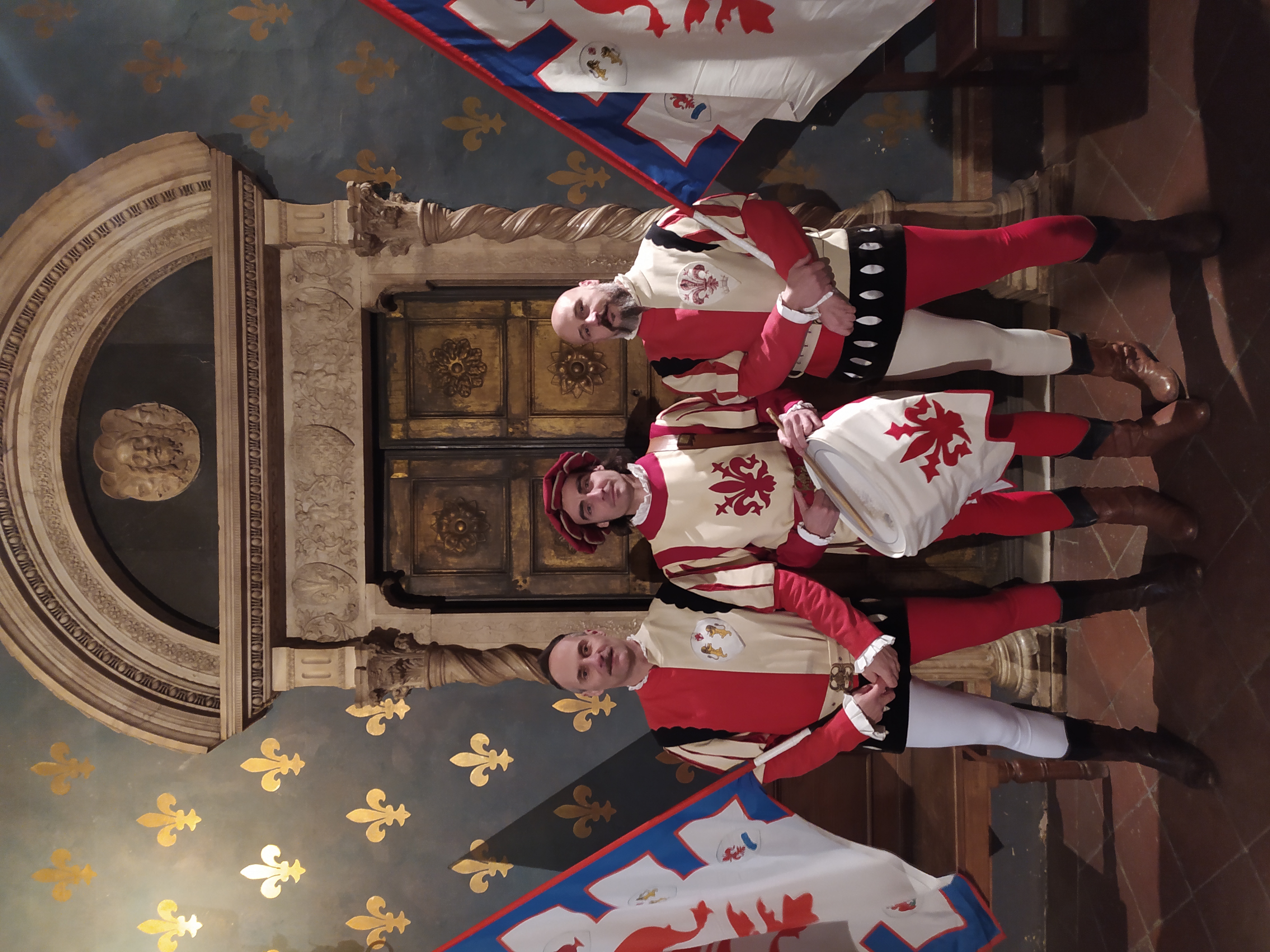 Exhibition curators, from left to right: Gian-Luca Pasquini, Claudio Manes Mariani and Massimo Marmugi
I Bandierai degli Uffizi
by Luciano Artusi
The Bandierai degli Uffizi were formed within Calcio Storico Fiorentino some time after the devastating flood of 1966.
It was far from simple.
But let us start at the beginning:
It began with a bundle of sixteen mud-covered flags tied together with string. On the cardboard tag threaded through the string, someone had written the word “bogus” in capital letters.
The flood had made them unrecognisable from a heraldic point of view, but they aroused curiosity because they had been labelled “fake” even though they belonged to the association re-established in 1930 and were duly recorded in its inventory.
After washing them, although they had all turned hopelessly brown from oil and mud, it was possible to read the symbols: they represented the sixteen principal Magistracies and the most important offices in sixteenth-century Florence.
Why was it that, after the end of the war and therefore since 1947, they had no longer marched in the Corteo?
It is a mystery.
Perhaps the costumes worn by the standard-bearers who carried them were no longer available?
Or perhaps they were not considered necessary to represent those Renaissance institutions, unlike the insignia of the guilds, the districts and the Republic?
Who knows what the real motivation might have been.
In any case, the point was that since the postwar period
those flags had remained locked in a cupboard until someone, whose identity is unknown, wrote the famous “fake” label, causing them to be forgotten.
After the costumes, weapons, accoutrements and flags of Calcio Storico—devastated by the waters of the Arno—had been restored, the idea arose of giving those “false” insignia a new life and restoring them to the prestige they deserved.
It was proposed that they be remade, as had been done for the other items by the cloistered Benedictine nuns of the Monastery of Santa Maria di Rosano.
After the President, the Provveditore and the Committee had been duly informed, it was decided to have them remade.
Having been in contact with Professor Vittorio Dini of Arezzo’s Giostra del Saracino, who had founded the flag-waving group within that institution, I enthusiastically proposed establishing a similar group in Florence.
But the Maestro di Campo and Provveditore, Colonel Aldighiero Batini, shook his head several times and said candidly, “Why burden ourselves with green wood?
Aren’t the many difficulties we face every day enough?”
(The expression refers to taking on unnecessary burdens, like carrying heavy green wood that will not burn well in a fireplace.)
And he was quite right, for there were so many problems facing Calcio Storico after the flood, such as finding suitable training spaces, recruiting young standard-bearers willing to learn the art of “maneggiar l’insegna” (flag handling), and making new costumes and lightweight flags with weighted poles. It was a truly arduous task.
However, the idea fascinated me so much that I brought the subject up again, so convinced was I of the importance that a group of flag-wavers could have in the future.
We then tried to make the proposal more persuasive, suggesting to the Committee that the Magistracies could be reconstituted at minimal cost by making simple tights and jackets instead of recreating the more elaborate costumes worn by the other members of the Procession.
The proposal was accepted, and with that approval we immediately set to work.
On our friend Vittorio Dini’s advice, we got to know a group of novice flag-wavers whom a Franciscan friar from Figline Valdarno, Don Ermenegildo Zurlo, had already begun to train. Don Gildo was thin, with a somewhat gaunt face, but always serene and illuminated by two bright blue eyes.
Don Gildo, as he was known, was nicknamed “Piombo” (“Lead”) because he was always collecting this malleable metal to make weights for flagpoles. We soon became friends, and his boys put on the new Bandierai degli Uffizi costumes and began handling those famous flags—no longer “fake”, but radiant in their colours and meaning.
However, the arrangement proved difficult to sustain: the boys lived far from Florence and could not easily attend Florentine events. Moreover, the costumes were used in other settings where Calcio Storico was not present. For these reasons, the collaboration had to end.
Thus, in 1973, a new group was formed with the help of several young people who were already part of Calcio Storico.
At first they were just four.
With passion and dedication, little by little, the boys learned the art of handling the flag, which they themselves began to teach.
The group gradually grew in a spirit of fraternal friendship, and Sergio Chiari—a former pallaio—was appointed its leader.
He was succeeded by Carlo Piagentini, then Domenico Montagnaro, Daniele Francioni and then Gigi Vitali.
In the beginning, choreographer Paolo Vestri helped us out, a valuable collaboration that was interrupted due to his move outside Florence for work.
The flag-waving group included Ricciardo Artusi, Andrea Faini, Andrea Ceccherini, Marco Consigli, Alvaro Ghini, Fabrizio Morucci, Andrea Croci, Gianni Greco, Paolo Mastursi, Uberto Ardovini, Angelo Profeti, Antonio Marrone, Gianni Ricci and Marco Bartoloni. The drummers were Andrea Capanni and Andrea Venturoli, both graduates of a conservatory.
Guided by the Tuscan proverb “A penna a penna si pela l’oca” (“A goose is plucked one feather at a time”), the flag-wavers gradually improved, becoming capable, then skilled, and eventually outstanding.
Today, among the 23 groups that make up Calcio Storico Fiorentino, the Bandierai degli Uffizi and their musicians stand out for their energy and colour. They are also known more simply as the Florentine flag-wavers.
For more than fifty years, the Bandierai degli Uffizi have proudly performed with their insignia, no longer regarded as fake but now widely recognised, following technical principles that date back five centuries.
Time has flown by.
Years have passed, filled with memories of important events abroad where the Bandierai even represented Italy. Many flag-wavers have become fathers, and their hair has gradually turned white.
Their smiles, however, have remained unchanged, as have those of today’s young flag-wavers, who—like their predecessors—are always ready for playful jokes and teasing, yet are unsurpassed in expressing the dignity and spirit of the standard-bearers of the 1529–1530 siege.
For many years now, the Bandierai degli Uffizi have been a source of unity among all the Calcio Storico groups, joined by the cry: “Viva Fiorenza!”
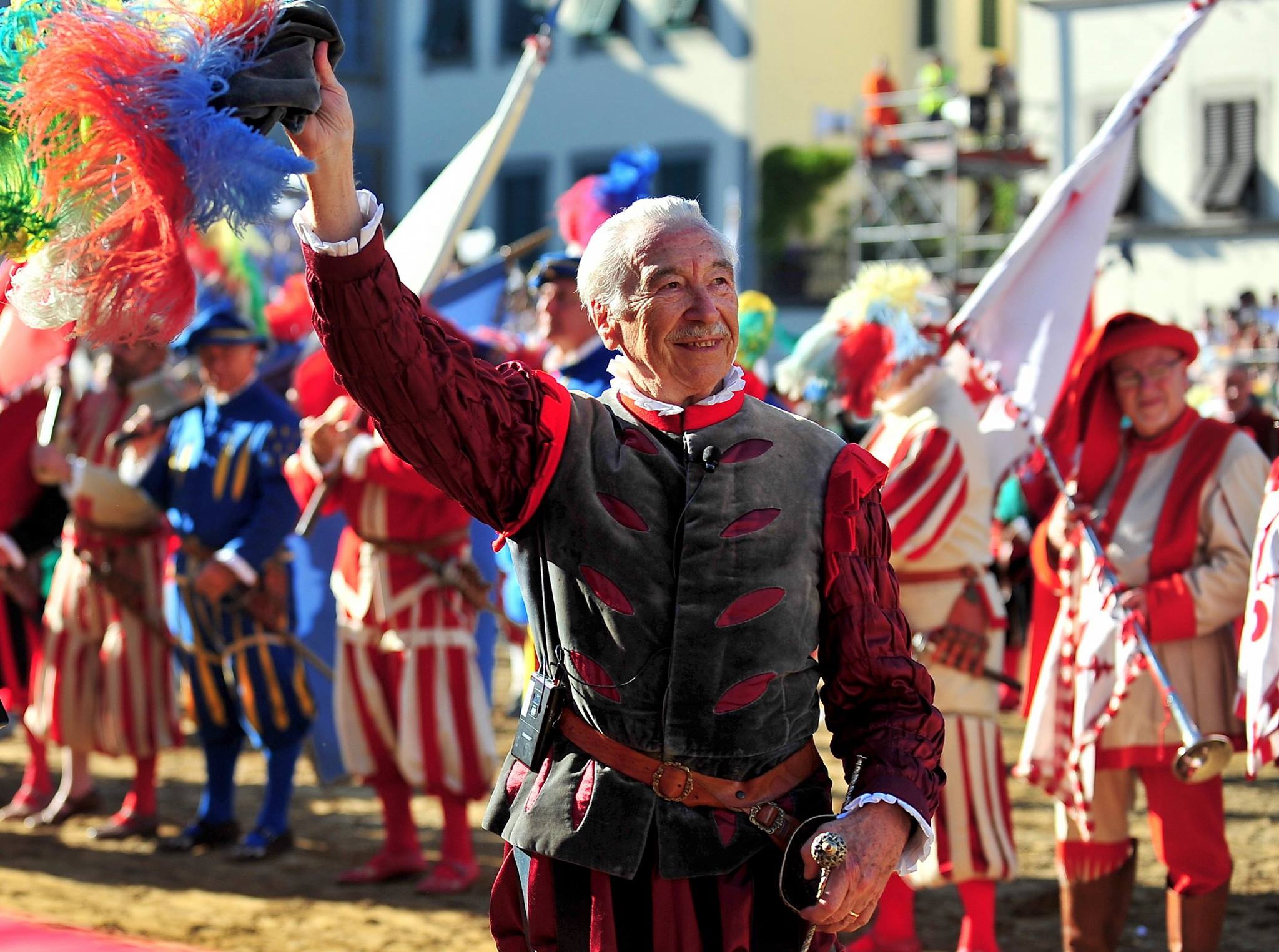 Luciano Artusi
by Filippo Giovannelli
Good opportunities often arise during life’s most difficult moments. As the saying goes, “When one door closes, another opens.”
It was not an easy time. We have all faced moments of loneliness, when friends can sometimes help us through.
It did not take much: an invitation and a few words.
“Come on, don’t stay at home. Come to the Palasport at nine on Monday evening. We’re a fantastic group of guys. I’ll introduce you to Gigi—you’ll see, we have fun.”
I had known Lorenzo since early childhood, and his words helped me enormously. That was the beginning of a new adventure that became, and still remains, a great passion. I devote myself to it wholeheartedly and with unwavering enthusiasm.
The first years were a time of learning. Becoming a flag-waver was not easy, but everyone helped me find my place among the Bandierai degli Uffizi. It was a close-knit group, united by common goals. In 1999, the disappointment following a recent split was still keenly felt, but everything pointed towards a bright future.
Many had left the group for different reasons: some did not share our outlook, while others felt too old for this kind of activity. A new generation, guided by people who understood the group’s strength through their own experience, gradually helped it grow again.
A few years later, the need for a breakthrough grew stronger. We had to wait for new opportunities to arise—sometimes by chance, sometimes thanks to a little initiative. It had become clear that no one had planned a development strategy. Until then, performances and events—the central goal of any flag-waving group—had often depended on personal preferences rather than on creating opportunities that satisfied the members as a whole.
For years, we had considered setting up a non-profit association to address organisational shortcomings and raise funds to replace equipment that had become unusable over time. The costumes were thirty years old; worse still, the flags were worn out and no longer suited the standing of the group or the city it represented. The Bandierai degli Uffizi were the official flag-wavers of the Municipality of Florence, a title coined by the then Councillor for Popular Traditions, Eugenio Giani. They represented the city at public events, as part of the wider Historic Procession of Calcio Storico Fiorentino.
We finally found the courage, with the approval of the municipal offices, to establish the ASD Amici dei Bandierai degli Uffizi. This began a journey that, despite its difficulties, led to the first major event: the celebrations for the group’s 35th anniversary.
2008 was a year of intense effort. Everyone worked hard to organise outstanding initiatives, foremost among them the wonderful exhibition in the Sala d’Arme of Palazzo Vecchio. Many members contributed by writing the texts, designing the panels, collecting photographs and materials, and producing videos. These efforts remain vivid in the memories of those who took part.
I remember those days of preparation and installation as moments of great joy and fun. The exhibition is recalled in several publications and remains an indelible sign of our shared efforts. I also remember two great figures in the group’s history: Filippo Galli, a charismatic organiser and the best “people manager” I encountered during my years in the Procession, and the legendary Gigi Vitali, the longtime leader of the Bandierai degli Uffizi, who welcomed me warmly on that autumn evening. I learned a great deal from him; he was a mentor to me!
In 2013, for the group’s 40th anniversary, initiatives planned in previous years came to fruition. Chief among them was a beautiful documentary film that conveyed the essence of the Bandierai degli Uffizi to the city. The project was worthy of the Medal of the President of the Italian Republic, news of which was announced on the evening of the screening in the Salone dei Cinquecento at Palazzo Vecchio. A new photographic book was also published.
In 2015, with great regret but also with the knowledge that I could continue serving Florence, I left the Bandierai degli Uffizi for another role. I did so with the same love and passion shown by the hundreds of volunteers who help bring the great historical reenactments of Calcio Storico Fiorentino to life.
It was not easy to give up, for the common good, the Monday evening training sessions, conversations over a cold beer at midnight, and the friendship of so many young men with whom I had shared hours, days, weeks and years travelling all over the world.
Our warm, affectionate relationship has never faded; those friends have remained friends.
On this special occasion, fifty years after its foundation, I wish the Bandierai degli Uffizi a flourishing future, full of the passion that honours the group and will shine through the celebrations of this anniversary.
Long live Fiorenza, long live the Bandierai degli Uffizi!
Viva Fiorenza, viva i Bandierai degli Uffizi!
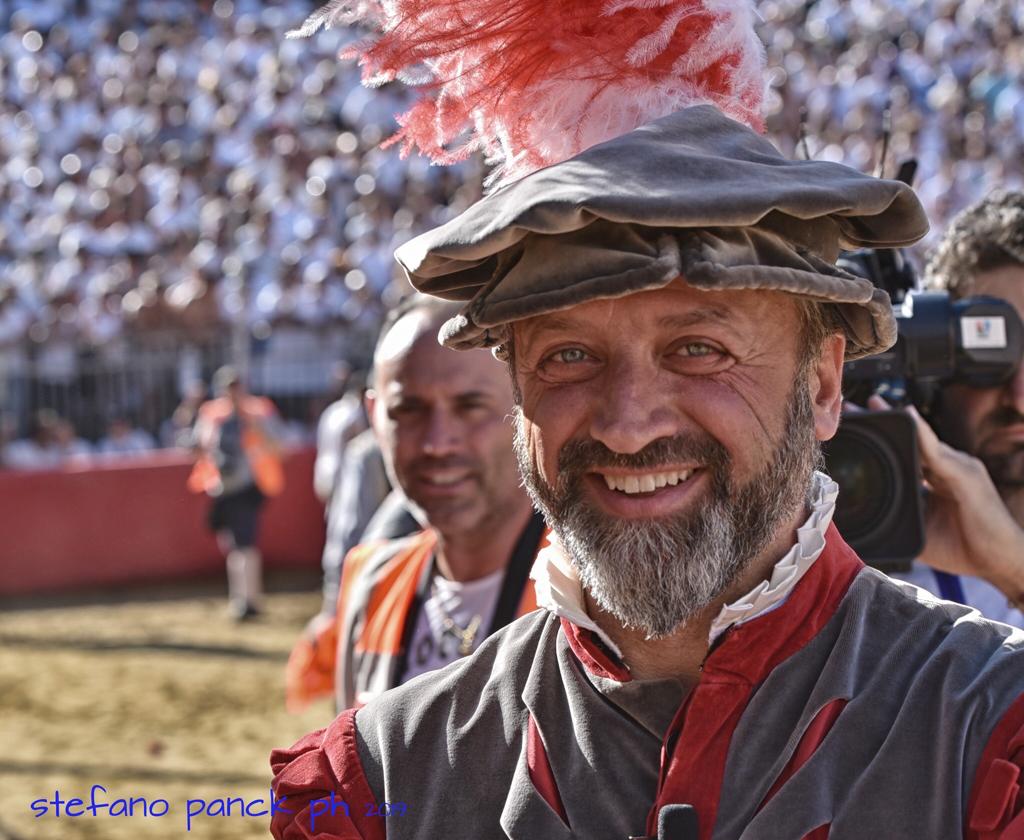 Filippo Giovannelli
by Antonio Marrone
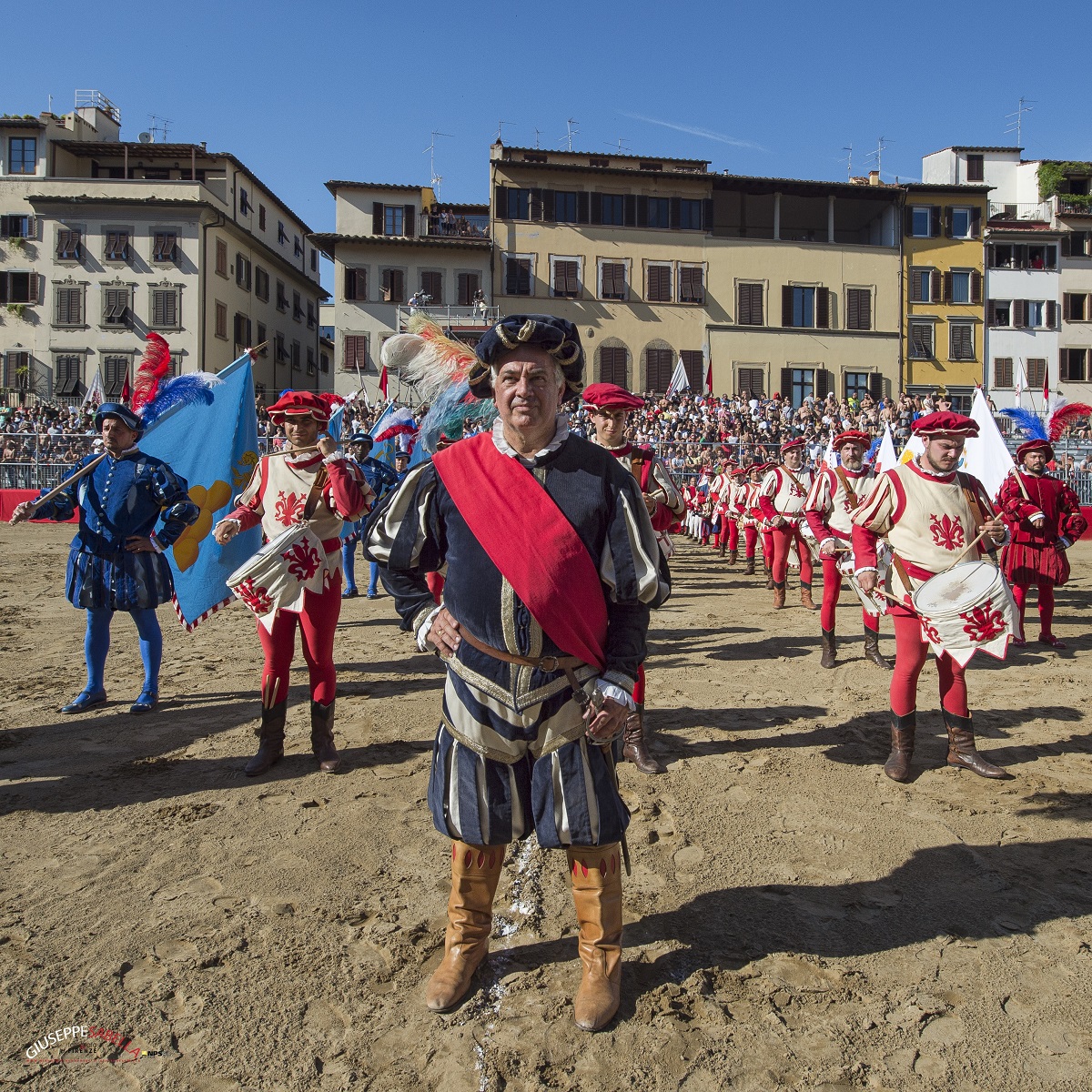
The Bandierai degli Uffizi are the official flag-wavers of the Municipality of Florence. They are part of the Historic Procession of the Florentine Republic and of Calcio Storico Fiorentino. We are a diverse group in terms of personality, skills and professional backgrounds; these differences create a unique bond of solidarity and friendship. Spending time together is what unites us. In recent years, we have taken part in an average of about 85 performances each year.
Life in the group also revolves around two training sessions each week. These strengthen the unity of our performances and help us offer the best possible representation of our city, blending the rhythm of the drums with the movement of the flags.
Alongside our work and family commitments, we meet regularly to train and prepare for performances. Tours and events away from Florence are another opportunity to strengthen friendships. Over the years, we have also created other opportunities to spend time together beyond our main activity of historical reenactment.
Over the past fifty years, the group has grown from a small number of members, thanks to their commitment and determination. The flags we carry represent the sixteen Magistracies that existed in historic Florence. By 1974, just one year after the group’s founding, we already had sixteen standard-bearers, each displaying the emblem of a Magistracy on their chest and flag. We continued to grow, taking part in more performances and travelling abroad. In 1976, we took part in the Historic Procession that marched along Fifth Avenue during New York’s Columbus Day Parade, as part of an impressive Florentine delegation.
Events such as the Scoppio del Carro at Easter and the Calcio Storico matches in June fill the members of the Historic Procession with pride and joy, especially the Bandierai, who perform in front of their home crowd.
In 2015, we proposed supporting the restoration of the Marzocco statue, a copy of Donatello’s famous work located on the Arengario of Palazzo Vecchio.
With the support of ENEL and the company La Marzocco, and in collaboration with the Municipality of Florence, we inaugurated the restored statue on 1 May 2016, during the 23rd edition of the Trofeo Marzocco. A plaque beside the pedestal commemorates the Bandierai degli Uffizi’s contribution. We also produced a small publication about the restoration, entitled “Marzocco, il Leone di Fiorenza”. In 2018, on the occasion of the group’s 45th anniversary, the Ministry of Economic Development issued a commemorative stamp honouring Florence and the Bandierai degli Uffizi’s long history. The stamp featured two flag-wavers and the group’s logo, together with symbols of Palazzo Vecchio, the dome of Santa Maria del Fiore and the Uffizi Gallery.
Over the years, we have met other flag-waving groups and shared wonderful experiences, both during performances and in our personal lives. These encounters led to twinning relationships with groups from Asti, L’Aquila, Scarperia, San Gemini and Calvi dell’Umbria. These bonds reflect our shared commitment to historical reenactment and volunteering.
Our group has experienced extraordinary moments in places such as Mexico City and Japan, always with the aim of honouring Florence. There have also been painful moments, especially when we have lost members and friends who remain deeply missed.
This exhibition retraces our group’s history and presents it to Florence and the world as a living part of the city’s tradition. It invites visitors to imagine the atmosphere we experience whenever we put on our costumes, take up our flags and drums, and demonstrate the art of “maneggiar l’insegna” to the rhythm of our music.
Captain Antonio Marrone
Viva Fiorenza, viva i Bandierai degli Uffizi!
 Antonio Marrone