
The flag is the flag-waver’s working tool. It consists of a pole, a counterweight, a handle with a protective covering, and a flag cloth. These components have changed over time, reflecting a substantial evolution in design and technology.
The pole
The first poles were made of wood. Their particular use meant they had to meet specific requirements, so they were not easy to source.
They were tapered—wider at the bottom and narrower at the top—and made of steamed beech. They needed to be as flexible and sturdy as possible, but not so dry that they risked breaking.
Because wood is a natural material, leaving a fully assembled flag, with its cloth attached, leaning against a wall for a long time after a performance could cause the pole to twist or warp.
The cloth therefore had to be removed regularly and the pole hung on a nail away from strong heat sources. The counterweight kept the pole under tension, helping to reduce the risk of warping.
The counterweight
Modern counterweights are made of iron and manufactured industrially, which ensures that they are all alike.
On the old wooden poles, the counterweight was made of lead by hand, often at home, by volunteer craftspeople from the historical procession and by municipal warehouse staff. Moulds were built to cast the lead, a metal that melts at relatively low temperatures.
Everyone was encouraged to contribute any lead they had at home to make new, complete poles. When a pole broke, its counterweight was recovered and reused.
The lead counterweight was attached to the wooden pole in two ways. One method was to force the pole into the counterweight’s central cavity; because lead is soft and malleable, it could hold the wood securely. Alternatively, two wood screws were used, with their countersunk heads completely embedded in the lead to avoid creating a hazardous point for the flag-waver’s grip.
This simple but laborious method had several drawbacks. Early poles had little protection around the lead at the base, so when a flag fell after a failed throw, the lead could slip downwards and become deformed.
Improved casting methods and the introduction of more effective leather grips made the poles less prone to deformation. The first lead counterweights, misshapen by repeated falls, were nicknamed “cipolloni” because they resembled large onions; they often had to be hammered back into shape before a performance.
The protector and handle
At first, the lead at the end of the pole was protected by a round piece of leather. It often wore out and could not provide reliable, lasting protection. Over time, thicker and sturdier leather grips were introduced. Sewn into a sheath around both the lead and the pole’s handle, they formed almost a single unit.
Rubber protectors, originally developed for billiard cues, were later attached to the pole with adhesive tape. This made the lead-weighted end stronger and more durable.
The flag cloth
Following an old tradition, the first flag cloths were made by joining and embroidering pieces of lining fabric. They were genuine works of sewing and embroidery: pieces of different colours were joined with decorative stitching to create the design of the magistrature being represented.
These cloths were delicate and heavy. Within a few years, they were replaced by cloths with designs applied directly to the fabric, which were more flexible and easier to handle during flag routines.
Two fabric tapes reinforced the cloth near the handle, where wear is greatest during the preparation and execution of throws and at the point where the cloth meets the pole. At the base of the wooden pole, where the lead counterweight began, two small leather loops were fixed with nails. The ends of the tapes were threaded through these loops to secure the cloth more firmly.
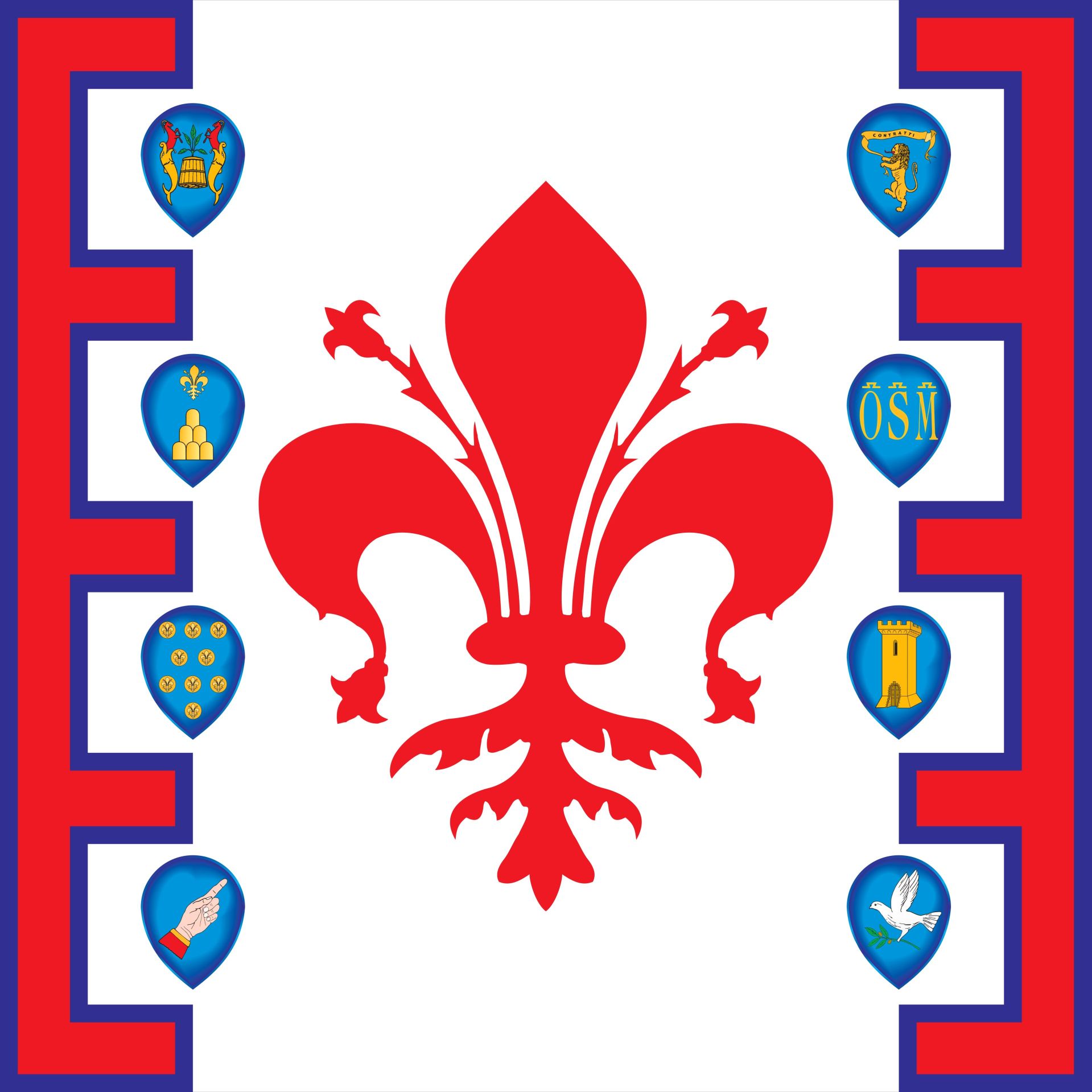
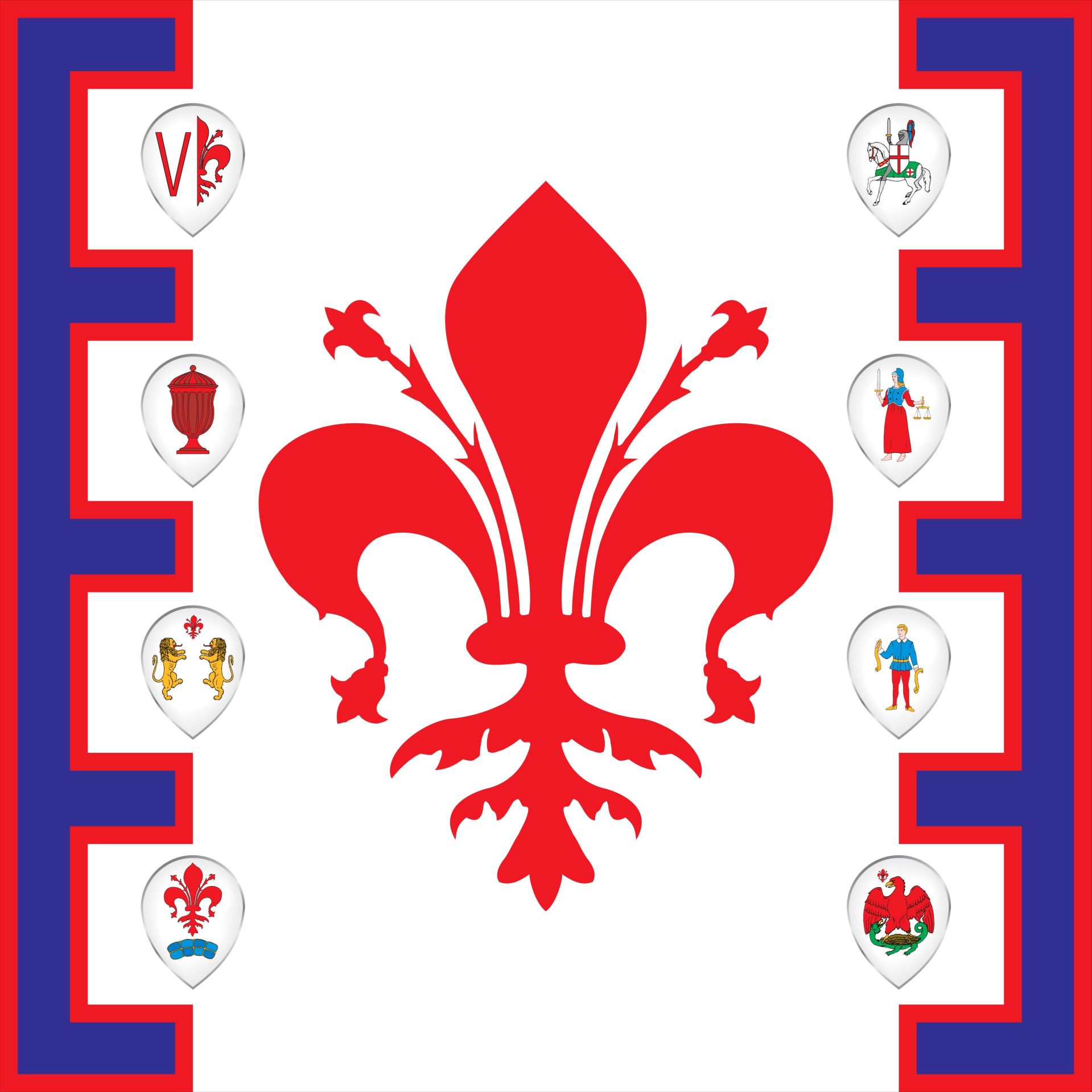
For about three decades, each cloth represented a single magistrature. From 2001, two flags were adopted: one for the blue flag-wavers and one for the red flag-wavers. Each flag brought together eight magistrature insignia around Florence’s Red Lily, displayed in the centre of the cloth.
 |
 |
Modern equipment
The major change came with the introduction of fibreglass poles, which replaced wooden ones and brought several benefits.
The first was safety: wooden poles sometimes broke during routines, creating a significant risk of injury to people nearby. This problem has not recurred with fibreglass poles, which are also more flexible and allow more dynamic movements and tricks.
Another advantage is consistency: today, the poles are uniform, so flag-wavers no longer have to adjust to differences caused by handmade variations. Iron counterweights are mass-produced with consistent weight and shape.
The end of the pole is now covered by a black rubber sleeve, providing a consistent, secure grip and a protective end cap known as the “rubber tip”.
The current flag specifications are:
Pole
- Length: 176 cm
- Weight: 1,000 g
- Flexibility: 20 lb
Flag cloth
- Dimensions: 135 × 135 cm